Coach Resource Center · Run
The State of Golf Coaching: 2026
The golf boom is changing who plays, where people learn and how coaches earn a living. Keeping golfers engaged may be the industry’s next test.



Coach Resource Center · Run
The golf boom is changing who plays, where people learn and how coaches earn a living. Keeping golfers engaged may be the industry’s next test.
Golf is booming. The business of coaching is changing with it. A record 48.1 million Americans participated in golf in 2025, many through simulators and off-course experiences. Yet only a minority take lessons. For coaches, more golfers don’t automatically mean better economics: facility fees, marketing demands, and new technology complicate the business. The opportunity is to turn first lessons into lasting improvement, repeat students, and a more sustainable livelihood.
Grow
Three questions shape whether a golfer contacts you. See your page from their side, then use a four-step phone check to fix the first unclear handoff.
Build
A copyable five-line price card that shows the real offer, explains legitimate variables, and gives golfers a clear next step.
At Toad Valley Golf Course in Pleasant Hill, Iowa, shirts and sweaters gave way to simulators. In his May 2026 Golf Digest report, Paul Sullivan described a public course that replaced its pro shop with indoor golf space. Operator Allison George told him hourly simulator bookings produced more money than an hour of pro-shop sales. It was a specific change in what a golf business offered its customers.
The same question faces coaches. Golf’s audience has grown. People can encounter the game at an entertainment venue, maintain a handicap through nine-hole rounds, learn from a phone or spend a winter practicing indoors. A lesson on the range remains important, but it now sits inside a much wider set of ways to participate, practice and pay for improvement.
That creates opportunity and work. A coach has to help a golfer choose useful instruction, make it fit a real schedule and budget, and keep the thread of improvement intact between appointments. At the same time, the coach needs a business that can withstand facility costs, seasonality and the time that teaching does not leave available for everything else.
The defining question for golf coaching in 2026 is how to turn a larger audience into lasting improvement and a sustainable business. More first lessons matter. What happens after them matters just as much.
Start with the scale. The National Golf Foundation counted 48.1 million Americans age six and older participating in golf in 2025: 29.1 million who played on a course and 19 million who participated exclusively off-course. The on-course group includes people who also used simulators, ranges or entertainment venues. These are two non-overlapping groups, not a count of every golf activity added together. Golf Industry Facts.
Across on- and off-course formats, participation grew approximately 41% from 2019 to 2025. On-course golf added almost five million participants over that period. The off-course-only audience is especially important for coaching: millions of people have already tried something recognizable as golf without yet taking it onto a course. Participation analysis.
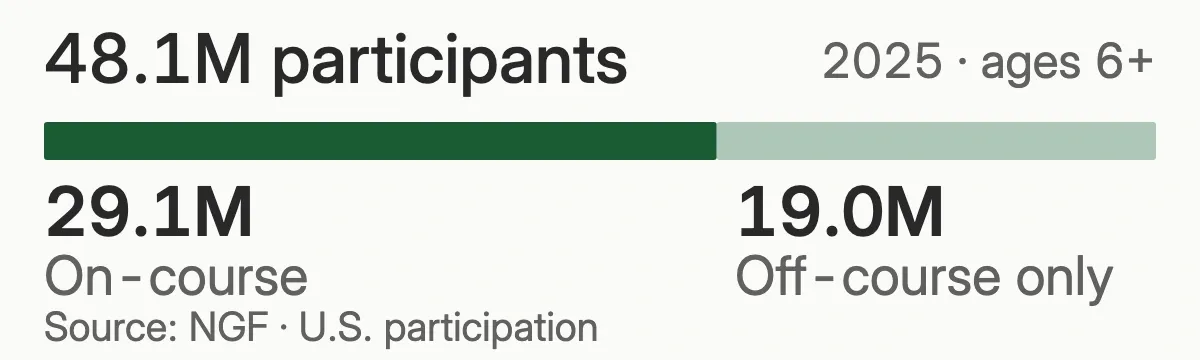
Figure source: NGF research
The increased activity is visible on the course, too. Americans played an estimated 549 million rounds in 2025, according to NGF figures reported by the American Golf Industry Coalition. It was the fourth record-setting year in five. This activity occurred on roughly 16,000 courses at 14,000 facilities, rather than on a dramatically expanded course footprint. Rounds snapshot and December 2025 rounds report.
The next record is not guaranteed. First-half 2026 play was just over 4% ahead of the comparable 2025 period, but July and August brought declines. By the end of August, year-to-date rounds were about 1% ahead, with weather contributing to regional volatility. For a coach, an annual national gain can coexist with a quiet month, canceled outdoor sessions or an uneven local season. June update and August update.
The distinction between golf participation and lesson demand is easy to lose. A golfer can play frequently without taking instruction. Someone who enjoys a simulator with friends may want another social evening rather than a swing assessment. A beginner can be interested in improving but unsure whether a lesson will be welcoming, useful or worth the money.
The most readily accessible national instruction estimates are older than the participation figures. An NGF analysis published in September 2024 estimated approximately 5.2 million lesson-takers, nearly 27 million annual lessons and more than $1.5 billion in annual instruction spending. It described lesson volume as the previous year’s activity. The same analysis put professional instruction at about one in five golfers and identified a larger group of non-lesson-takers who expressed at least some interest. These are dated estimates, not fresh counts of 2026 customers. Instruction analysis.
The distance between wanting to improve and paying a coach remains part of the story. Participation establishes the size of golf’s audience. It does not tell us how many interested golfers become lesson buyers or how often they return.
A first appointment is a business decision as well as a teaching opportunity. The golfer needs to understand who the coach helps, what a lesson involves and what it costs.
Serving that audience begins with learning what people want from the game. A healthy tee sheet, an active range and a busy entertainment venue each contain different kinds of interest. The next step needs to make sense to those golfers.
A larger golf population is also a broader one. In 2025, 8.1 million women and girls played on-course, representing 28% of that population. Just under four million juniors played, up 58% from 2019. Asian, Black and Hispanic on-course golfers numbered 7.7 million, or 26%. These demographic groups overlap; they cannot be added into separate slices of the market. Participation demographics.
For coaches, the useful response goes beyond a different photograph in a brochure. A parent arranging a junior session, an adult beginner and an experienced player returning after years away can all want instruction, but they may need different explanations, formats and schedules. The category “golfer” tells a coach very little about someone’s confidence, available practice time or reason for taking a lesson.
The USGA provides an independent view of participation through scores posted under the World Handicap System. 3.68 million U.S. golfers maintained a Handicap Index in 2025, up 8.2% year over year. Nearly 15 million nine-hole scores were posted—14,998,824—up more than 46% since 2020. These are handicap-system records, not all golfers or all rounds played. They measure activity within a particular engaged population. USGA’s 2025 Golf Scorecard.
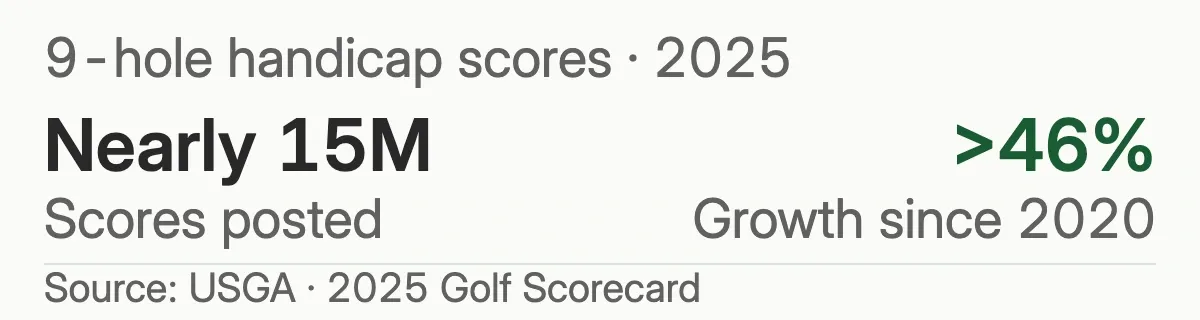
Figure source: USGA Golf Scorecard
The appeal of a shorter format is straightforward: golf has to fit into the day someone actually has. Nine holes, a range visit and an indoor practice hour are different experiences, but each can offer a manageable way to keep playing. The score-posting figures do not prove that golfers want shorter lessons. They do give the industry a reason to take flexible participation seriously.
A coach might respond with nine-hole sessions, after-work groups or focused appointments with one purpose. The value is a format the student can repeat. A modest plan that fits the golfer’s life can be more useful than an ambitious one requiring an unavailable practice schedule.
The boom creates pressure as well as opportunity. In a May 2026 Golf Digest editorial, Max Adler described juniors using simulators on a fine spring day because local tee sheets were crowded. Youth on Course CEO Adam Heieck told him that demand was making access harder to provide. The piece is reported observation and commentary, not a national measurement of how many young golfers have been displaced. Adler on the access problem.
There is a constructive counterpoint in municipal golf. Writing in January 2026, Fried Egg Golf’s Garrett Morrison highlighted Buffalo Dunes in Garden City, Kansas, where superintendent Clay Payne and collaborating architects transformed the course on a budget he reported at around $600,000. Morrison also described the obstacles to affordable new public courses, including land costs and regulatory processes. His account concerns particular projects and architectural judgment, not a national construction-cost benchmark. Morrison’s public-golf reporting.
Together, those accounts make a distinction that participation totals cannot: more people wanting to play does not necessarily mean more convenient places or times to do it. A golfer can have the money for an initial lesson and still struggle to find somewhere comfortable to practice afterward. A junior can enjoy coaching but have limited access to the course where that learning becomes a game.
Access is part of the coaching relationship: where can this student practice, what will it cost, and when can they return? Instruction can acknowledge those constraints even when a coach cannot control the tee sheet or family calendar.
Indoor golf is more than a winter substitute for the range. It changes opening hours, the kinds of customers a facility can serve and the way space earns revenue. For coaches, it can offer a teaching environment with repeatable conditions and ready access to ball-flight data. It also creates a different set of costs and operating decisions.
The participation growth is clear. NGF’s April 2025 simulator white paper estimated 8.1 million simulator and screen-golf participants in 2024, compared with 3.8 million in 2015. More than half of the 2024 participants had not played on a golf course during the previous twelve months. That is evidence of reach beyond traditional golf, not a forecast that those people will buy lessons or move onto a course. Simulator research.
Supply is a separate measure. In November 2025, researchers identified at least 1,500 commercial simulator businesses, nearly three times their 2022 database count. The database is not exhaustive, excludes simulators at courses, retailers and club-fitters, and grew through improved discovery of existing venues as well as openings. Nor does it establish how many venues offer coaching. Venue database update.
Sullivan’s Golf Digest reporting makes the operating choices concrete. Jimmy Vukanovich’s Indoor Golf Club in New Jersey offered monthly tiers of $135, $250 and $400, alongside $75 hourly access for non-members. In Stamford, Connecticut, Todd Becker and Jamie Scholz installed seven TrackMan bays and short-game turf at 1868 Golf Club, with an annual membership priced at $250 a month. Becker reported profitability after two months. Those are individual operator accounts, not representative margins or verified returns for an indoor-golf investment. The reported business examples.
The examples distinguish a place to practice from a place to hold an event. Both can use simulators, but a regular golfer paying to work on a game and a group paying for an evening out are buying different things. Instruction may be central to one facility’s purpose and an additional service at another. Counting both as indoor golf conceals that difference.
This matters when a coach chooses a teaching arrangement. Access to a bay does not automatically mean access to students. An entertainment venue may be full at the hours the coach wants to teach. A practice-focused club may have golfers with specific improvement goals but rules about who can deliver instruction. The relevant agreement includes who controls the appointment, who receives the customer’s payment and whether the golfer can practice there between sessions.
A simulator lesson price also needs a clear boundary. Does it include the bay, or does the student pay the facility separately? Is the quoted amount for one golfer or a group? Can the student stay to practice? These details affect both affordability and the coach’s revenue. Bay rental is not itself a coaching fee, and a membership is not necessarily a lesson package.
Ball-flight patterns and saved video can make feedback tangible. The teaching challenge is to choose which information matters to this student. Having more measurements does not establish better learning.
Indoor teaching may also help golf fit around work, darkness or bad weather. But the attraction should remain connected to the student’s goal: becoming more confident, enjoying a familiar course, preparing for a trip or learning to strike the ball more consistently. The location is useful because of what the coach and golfer can do there together.
Whether these spaces support repeat practice at a workable price is where the facility story meets the lesson business.
Ask what a golf lesson costs and the honest answer begins with another question: which lesson? Geography, duration, format, facility and the coach all change the offer. A clinic priced per participant is a different purchase from a private session, and a half-hour appointment is a different commitment from an hour.
The following are selected published-price examples, checked October 12, 2026. They are advertised U.S.-dollar offers from named providers, not transaction data, national price bands or a representative pricing sample. Availability and terms can change.
| Provider / location | Offer | Duration | Advertised price | Eligibility / inclusions |
|---|---|---|---|---|
| Morley Custom Golf / Eau Claire, WI | Adult lesson | 60 minutes | $60 | Outdoor green, cart and range-ball charges additional |
| CoachED / Richmond, VA | Adult private lesson | 60 minutes | $150 non-member; $120 member | Separate member eligibility applies |
| Peacock Gap / San Rafael, CA | Adult lesson | 60 minutes | $180 | Provider also lists multi-hour packages |
| Meadow Lakes / Prineville, OR | Group lesson | 60 minutes | $40 per person | Four or more players; posted junior group discount of $5 per person |
| The Rail / Springfield, IL | Junior lesson | 30 minutes | $40 |
Sources: Morley, CoachED, Peacock Gap, Meadow Lakes, The Rail and PGA TOUR Superstore.
There is also a much higher-priced end of the business. Golf Digest’s 2026–2027 teacher ranking, published September 16, 2025, listed Mark Blackburn at $1,500 an hour and Dana Dahlquist at $950 an hour. Those are dated published rates for two widely recognized coaches, not typical prices or proof that the offers remain unchanged. They show why reputation and specialization belong in a pricing discussion without defining the ordinary lesson market. Published ranking and rates.
For the student, the total commitment matters. Six $100 sessions cost $600 before travel, practice or facility charges. Groups offer another entry point; packages can support continuity when their terms are clear. These examples cannot establish whether coaching is becoming more affordable nationally.
The coach’s side of the price is different again. In its 2026 Operations and Compensation Survey, Proponent Group reported that 56% of responding member coaches paid a revenue split to a facility, with the average facility share at 23%. Reported splits averaged 26% at public facilities and 19% at private clubs. The public summary does not disclose respondent count; this is a selective professional-member survey, not a national coach census. Survey findings.
Apply a 23% share to an illustrative $120 lesson and $27.60 goes to the facility, leaving $92.40 before the coach’s other costs. That calculation explains a contract arrangement; it is not a claim about every coach, a typical take-home rate or a national expense model. Different contracts may include different access, equipment or administrative support.
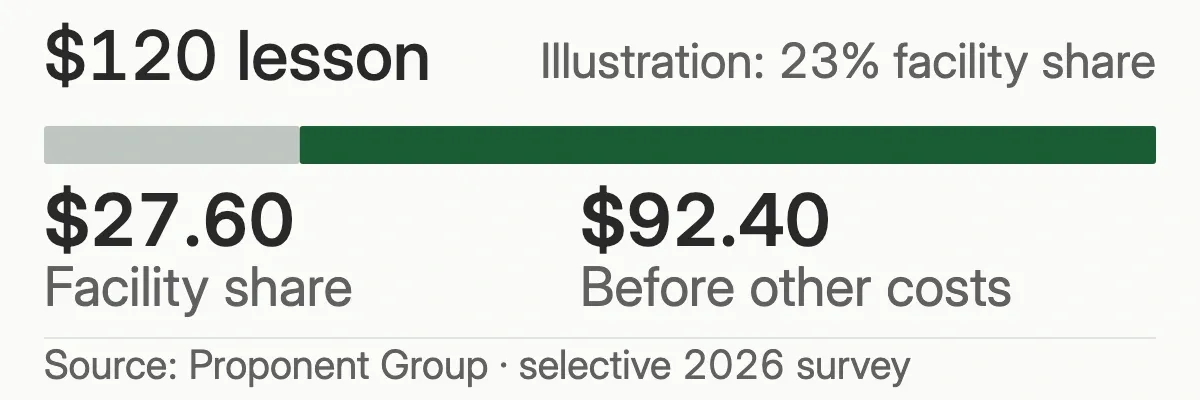
Figure source: Proponent Group survey
Rent, equipment, software, marketing, continuing education and unpaid preparation then complicate the arithmetic. The meaningful unit is not just an hour taught. It is the time and expense required to deliver that hour well, including the work that helps a student use it afterward. A full calendar can still leave a business vulnerable if cancellations, weather or facility charges change the result.
Proponent’s survey of prior-year activity found average annual coaching-related revenue of $210,139, with $32,978 in specified key expenses. Its reported $177,161 after those expenses should not be treated as salary or fully burdened net profit. Different employment and ownership models carry different costs. The survey is useful for understanding established member businesses, not for telling a new coach what they can expect to earn. Revenue definitions and results.
Private one-to-one lessons contributed $90,066, or 43% of average revenue. Long-term programs averaged $31,738, groups and clinics $24,120, and golf schools $8,060. Those selected categories do not comprise the full revenue mix. They do show that the sampled businesses were earning money through more than a sequence of unrelated private appointments.
A group can distribute the cost of instruction across several golfers. A longer program can make progress and expectations easier to organize. Both also require work: matching participants, coordinating attendance and delivering what has been promised. Selling a package creates an obligation to teach those lessons. It does not remove the need to keep students engaged.
Pricing pressure is uneven. In a separate July 2026 questionnaire, 39% of responding Proponent members said they had raised rates during the year. The public summary again omits sample size. That is a useful signal from these members, not a national price index or a measured percentage increase in lesson prices. Midyear questionnaire.
The professional pipeline remains active. The PGA of America’s October 2025 Secretary’s Report counted 24,578 members and 8,427 associates, for a combined 33,005. These categories include many golf-industry roles; associates are pursuing membership, and the total is not a count of certified teaching coaches. The report also recorded more than 24,000 coach-development course completions during 2025 to its reporting date. Those are completed courses, not unique coaches or newly issued certifications. PGA report.
LPGA Professionals reports more than 2,000 members across teaching, coaching and the wider golf business, an organization-wide figure rather than a U.S. coach census. TPI education is relevant to golf coaches, fitness professionals and medical providers, another reason not to add credential counts into a supposed teaching workforce total. Training matters, but a badge alone says less than an accurate account of a coach’s experience and approach. LPGA Professionals and TPI education.
Capacity matters alongside credentials. In Tod Leonard’s September 2021 Golf Digest reporting, Michelle Winkler described the pressure of pandemic-era lesson demand: “My bank account was very, very happy. But my mental state was not the best.” Her account belongs to that period and her experience. It still captures a business tension worth taking seriously: more paid teaching can leave less room for the rest of the job. Leonard’s reporting.
The economics of coaching therefore include a human constraint. A sustainable plan has to leave time for preparation, communication and recovery as well as billable sessions. Otherwise, growth can make the service harder to deliver precisely when more students need it.
Golfers can now encounter a coach long before they stand together on a lesson tee. A video can introduce a teaching style. A social account can establish a coach’s public identity. A subscription can deliver feedback remotely. A launch monitor can generate data during the appointment. These are related activities, but they are not interchangeable businesses.
The distinction is visible in Proponent’s findings. Direct online lessons represented just 1.5% of its members’ reported prior-year revenue, averaging $3,051 across the wider sample. Only 33% reported online-lesson revenue; among that subgroup, the median was $2,000. These denominators matter. The figures describe responding member coaches, not all online instruction or the size of the digital golf-content economy. Online-lesson findings.
In July 2024, Forbes contributor Erik Matuszewski reported that Performance Golf had generated about $90 million in 2023 revenue. Its business spanned instructional videos, golf schools, training aids and equipment. Founder Brixton Albert worked with coaches to produce and distribute content, making marketing and product distribution part of the model. This is an older reported company example, not audited industry revenue or a figure for one-to-one online lessons. Matuszewski’s business reporting.
There is no contradiction between a large instructional-content company and comparatively modest remote-lesson revenue for many traditional coaches. One business sells products to an audience; the other sells individualized attention and feedback. Their costs, capacity limits and customer relationships differ. Counting both as “digital instruction” can obscure what a coach is actually trying to build.
Social media sits between those models. Proponent reported that 82% of its responding coaches had Instagram accounts; among those account holders, average following was 4,200. A following is not a booking count, revenue figure or measure of teaching quality. It is evidence that maintaining a public presence has become part of many surveyed coaches’ work. Social-media findings.
A coach does not have to become a full-time creator to use that presence well. Clear examples of the golfers they help, the formats they offer and the way they explain a problem can help someone judge fit. The harder question is whether producing content supports the teaching business or becomes another obligation with an unclear return. Followers and views are easier to count than a durable student relationship.
The software market includes discovery, booking, payment, video analysis, remote feedback and student communication. Some products combine several jobs, while others specialize. The examples below retain vendor-published pricing checked October 12, 2026; features, eligibility, billing terms and fees can change.
| Tool | Main coaching use | Published pricing / context |
|---|---|---|
| PGA Coach / Coach+ | Profiles, booking, student management and PGA discovery | Free core for eligible PGA coaches; Coach+ $25/month or $250/year |
| Skillest | Online and in-person coaching, video, communication, scheduling and discovery | Coach subscription $59/month; blog lists commissions of 0% in-person, 1% hybrid and 13% online |
| CoachNow | Video, student communication and groups; higher tier adds calendar and billing | Monthly Pro $49.99; Academy $89.99; annual billing differs |
| Onform | Video capture, analysis, sharing and athlete workspaces | Monthly coach tiers $19.99, $39.99 and $59.99; multi-coach terms vary |
Sources: PGA Coach, Skillest’s coach page, Skillest’s published commissions, CoachNow and Onform.
Launch-monitor platforms such as TrackMan and Foresight Sports add hardware, simulator and performance-analysis costs that depend on the setup. Coaches also use ordinary calendars, invoicing and email tools. This overview is a set of vendor-described examples, not a ranking, endorsement or comparative study of student outcomes.
The business interest extends beyond small software subscriptions. Versant announced a deal to acquire Full Swing for approximately $530 million in cash on July 6, 2026, subject to purchase-price adjustments, and announced completion on August 3. Full Swing’s hardware and software span simulation, training and entertainment. The deal illustrates corporate interest in the infrastructure around play and practice; its purchase price does not measure the coaching market. Announced terms and closing announcement.
AI-assisted instruction is another product direction. Peter Morrice’s May 2026 Golf Digest reporting described Mustard’s swing analysis and coach-led instructional content. Golf Digest is a minority investor in Mustard and has consulted on its analysis and content, as its related coverage discloses. This establishes a commercially supported product development, not independent proof of teaching effectiveness. Product reporting and investment disclosure.
One booking platform offers another narrow signal. TeachMe.To’s 2026 annual golf report says bookings on its platform grew 60.8% in 2025 versus 2024 while its average lesson price fell 5.3%. Those are company-reported platform results, not national growth or pricing benchmarks. Changes in its coach and student mix can affect the comparison. Company report.
The proliferation of products makes the coach’s judgment more consequential. Someone can arrive with a saved video, an app-generated diagnosis and a launch-monitor number without knowing which one deserves attention first. In an April 2025 GOLF.com conversation, Peter Kostis put the distinction plainly: “Anybody can tell you what you’re doing wrong. Only a few people can tell you what to do that’s right.” This is a coach’s perspective, not a quantified evaluation of internet advice. Kostis and Gary McCord’s conversation.
What does a tool help this coach and student do? A video can preserve a reference, a calendar reduce coordination and a message reconnect practice to the previous lesson. Technology earns its place when that job is clear.
That brings the industry back to the relationship after the first lesson. Golf can generate interest quickly. Learning it takes time, and the time available to a recreational golfer is rarely as predictable as the enthusiasm they bring to a new session.
NGF’s August 2026 beginner analysis counted more than 19 million first-time on-course trials over 2020–2025, alongside just over four million net growth in the on-course population. Those are cumulative trials and a net change across the whole population, not a tracked group of beginners. Separately, it estimated that roughly one in four beginners becomes a committed golfer. None of these figures measures repeat lessons or retention with a particular coach. Beginner analysis.
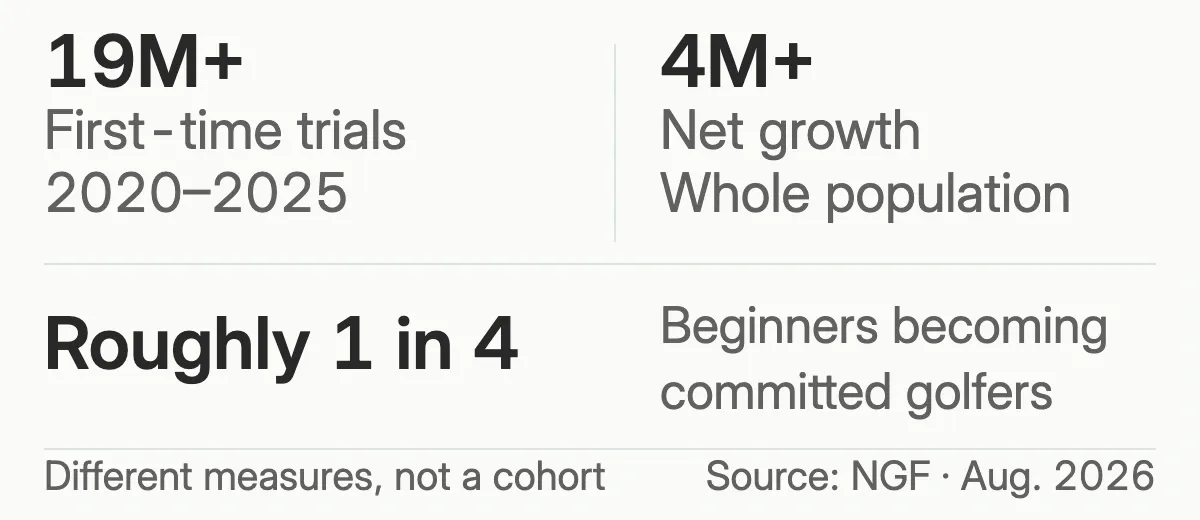
Figure source: NGF research
The numbers leave a question for coaches rather than supply a conversion formula. What helps someone keep finding value in the game? Coaching can be one part of that answer, but a golfer’s participation also depends on access, time, cost, companions and motivation. A useful lesson cannot remove every barrier. It can make the next step clearer.
In September 2026, Golf Digest’s Luke Kerr-Dineen asked six coaches for unglamorous advice that works. Their examples included keeping a reference for sound fundamentals, using consistent green-reading reference points and rehearsing deliberately. The common theme was improvement through repeatable work rather than a single revelation. These are reported professional perspectives, not a study proving a particular lesson-retention method. Kerr-Dineen’s coach conversations.
That distinction matters for a golfer who leaves a lesson with enthusiasm and then has forty minutes to practice next week. A manageable priority is different from a list of everything wrong with the swing. Continuity means the next appointment can begin with what the student actually tried, what changed and what still feels difficult. It need not begin with a fresh diagnosis that makes the previous work feel disposable.
The PGA of Great Britain & Ireland’s June 2026 student-retention guidance emphasizes timely replies, clear expectations and support between lessons. It is professional practice guidance, not a representative U.S. survey. Its underlying idea fits the broader evidence: the student relationship extends beyond the hour in which a coach is physically present. Student-retention guidance.
For a business, that work has a cost and a purpose. Recaps, feedback and progress conversations take time. They should be sized to the service being sold and the student’s needs. The promise should be clear enough that the coach can deliver it consistently, rather than implying unlimited attention or guaranteed improvement.
A repeat lesson is useful when it continues something the golfer understands. That might be a beginner building confidence, a junior learning to play a course or a regular golfer working toward a specific scoring goal. The format can vary. The shared task is helping the student connect the appointment to golf they can actually play and practice.
There is not enough evidence in this report to rank every coach pain point or attach a national percentage to poor follow-up. Nor do we have national repeat-lesson data. The retention argument is an interpretation of participation research, professional guidance and reported experience: attracting someone is valuable, but maintaining a useful relationship deserves equal business attention.
Four developments will help test that argument. First, whether shorter formats and indoor access make regular participation easier, rather than simply generate more first visits. Second, whether coaches can combine private lessons, groups and programs without overloading their capacity. Third, whether content and software help students follow a coherent plan, rather than increase the amount of advice they must sort through. Fourth, whether the industry becomes better at measuring continued participation and repeat instruction instead of celebrating reach alone.
These are BirdieYard’s interpretations and questions for the next edition, not statistical forecasts. Different coaches will find different answers. What they have in common is the need to deliver a service that a golfer can understand, afford, use and return to—and a business that leaves the coach able to keep teaching it well.
Golf’s larger audience is the starting advantage. The more durable opportunity is to help those golfers make the game part of their lives.
For practical companions to this report, see how golfers choose a golf coach and what a useful lesson pricing page should include.
This inaugural October 2026 U.S. report combines industry research, handicap-system records, association publications, selective surveys, published offers and attributed journalism. International association figures are identified. It contains no BirdieYard platform statistics or original survey.
The reporting cutoff is October 12, 2026; additional verification took place October 13, with actual access dates recorded. Participation primarily describes 2025, simulator participation 2024, instruction estimates a September 2024 publication, and PGA headcounts October 2025. Older accounts retain their dates.
Populations and units remain distinct: participants are not rounds, posted handicap scores are not all play, association members are not a teaching census, and a selective coach survey is not the national workforce. Advertised prices are not transactions; company sales, coach revenue and take-home income are different measures. No national price median or average is calculated. Beginner trials and net population growth are not used to compute a retained cohort.
Interviews are attributed to their original writers; BirdieYard did not conduct them. Operator accounts and vendor claims are identified. Software inclusion is not an endorsement, and this analysis does not establish that a particular product or process causes improvement or retention.
Secondary research combining U.S. industry estimates, USGA handicap-system records, association publications, selective coach surveys, six advertised lesson offers and attributed journalism. Reporting cutoff October 12, 2026; additional source checks October 13. No BirdieYard platform statistics, original coach survey, representative price sample or national pricing median.
Published by BirdieYard, a golf-coaching business platform. This report is based on secondary research, not BirdieYard customer, booking, revenue or retention data. Software descriptions and platform activity claims are vendor-reported; inclusion is not a ranking or endorsement.
| Ages 18 and under |
| PGA TOUR Superstore / U.S. retailer | Adult single lesson | 45 minutes | $79.99 | Confirm local availability and provider terms |
|---|