The Practice · Choose
How to choose a golf travel bag without buying twice
The right golf travel bag fits your clubs, airline, car, storage space, and appetite for risk. Use four checks before hard-versus-soft marketing makes the choice for you.


The Practice · Choose
The right golf travel bag fits your clubs, airline, car, storage space, and appetite for risk. Use four checks before hard-versus-soft marketing makes the choice for you.
Choose a golf travel bag by working backward from the full trip: your airline’s current rules, the packed weight and length of your clubs, how the case will move through airports and vehicles, and where it will live at home. Hard cases add rigid protection but take more space; soft cases are lighter and easier to store but may carry different airline-liability terms.
A golf travel bag can look enormous in a product photo and somehow become too small on packing night. The stand bag goes in. The driver keeps the zipper from closing. A pair of shoes claims the last useful corner. Then somebody remembers that four of these things still have to fit in one rental car.
That is why hard versus soft is not the first decision. The first decision is whether the bag fits the trip you actually take. Protection matters, but so do weight, wheels, storage, airline rules, and the awkward twenty minutes between baggage claim and the hotel.
The right travel bag protects the clubs you own without making the rest of the trip worse.
Before comparing zippers or padding, open the sports-equipment policy for every airline operating your itinerary. Do not rely on a general baggage page, an old forum answer, or the rule from your last trip. Golf bags can be treated as standard checked baggage while still having sport-specific limits on contents, size, weight, packaging, and damage claims.
American currently allows a golf bag with clubs, balls, tees, and one pair of shoes; its published golf-equipment and liability rules apply standard checked-bag fees through 50 pounds, waive oversize fees for the golf bag, and limit damage liability to equipment in a hard-sided case when the case is visibly damaged.
Delta’s current golf checked-bag requirements also use a 50-pound threshold and a 115-linear-inch ceiling, but a soft-sided travel bag requires a limited-release signature. Southwest’s golf-club policy accepts soft-sided cases under limited liability, waives oversize fees, and sets its own maximums. The point is not to memorize three airlines. It is to notice that the bag changes the contract, not just the packing job.
If a trip includes a partner airline, a smaller regional aircraft, or an international connection, check that operating carrier too. A bag that is acceptable on the first flight is not automatically acceptable on the second.
Not always, but you should check the operating airline’s policy before choosing. Some airlines accept soft-sided golf travel bags only under limited liability, while a hard-sided case may receive stronger damage coverage. Balance that difference against weight, storage, and vehicle space.
Measure your golf bag at its widest point and from its base to the top of your longest club, then compare those numbers with the travel bag’s internal dimensions. Leave room for padding and restraint without forcing the zipper or pressing on the longest club.
Airline definitions differ, so read the sports-equipment policy for your itinerary. Some carriers list only clubs, balls, tees, and one pair of golf shoes. Extra contents also use weight allowance and can crowd the equipment the case is meant to protect.
Updated October 6, 2026 after rechecking the five product pages, current prices, specifications, and the review excerpts supplied from seller and retailer pages. Prices are snapshots and can change. Review themes were used as bounded qualitative evidence, not representative performance or durability data. Airline policies, the search landscape, Golf Monthly’s disclosed review approach, and the earlier discovery-only community map remain part of the guide. BirdieYard did not test or rank these bags.
BirdieYard did not test, rank, receive, or get paid to feature these bags. Links are non-affiliate. Prices were checked October 6, 2026 and can change. Review themes are paraphrased from seller-hosted comments and retailer summaries; they do not establish typical performance.
Read our editorial standards and corrections policy.
Improve
A tee is a setting for the round, not a rank or a gender label. Understand forward tees and “the tips,” then choose for your game, the course, and the golf you want to play.
Improve
Consistency is not ten identical shots. It is knowing where most balls finish, how big your miss is, and whether that miss stays playable.
Featured Coaches
From a backyard net to Perform for Golf in San Rafael, Dylan Smith has kept the same aim: help golfers understand their swings. His RBFS system starts with four movements: turn, tilt, bend and sway.
A hard case puts a rigid shell around the golf bag. That gives the case more resistance to compression and can fit an airline’s stronger liability language, but the shell is usually the least forgiving object in the garage, hotel room, and car. It does not fold because your friends brought too much luggage.
A soft travel bag trades that rigid shell for lower empty weight and a body that can collapse for storage. The trade is real: the bag depends more on its padding, internal restraint, top support, and the way you pack it. Some airlines also make you accept limited liability. Soft does not mean careless. It means the packing system has more work to do.
Hybrid designs add a rigid top or partial shell to a softer body. They can be a sensible middle path when clubhead protection and storage both matter, but do not assume an airline will treat a partial shell as a hard case. If liability language is part of your decision, ask the carrier how it classifies the exact design.
You do not need a product ranking to narrow the choice. You need four honest checks, preferably with your golf bag, longest club, shoes, and the vehicle plan in front of you.
| Check | Question | What rules out a bad fit |
|---|---|---|
| Clubs | Does your actual golf bag fit without the longest club pressing against the top? | A tight zipper, crushed padding, or no room to secure the bag |
| Flight | Does the packed case meet every operating airline’s current size, weight, content, and case rules? | A case that starts too heavy or conflicts with liability terms you care about |
| Movement | Can you roll, lift, load, and stand it up without fighting the balance? | Weak-feeling handles, unstable wheels, or a shape you cannot control when packed |
| Rest of trip | Will it fit the planned car, room, and home storage—or should you borrow or rent instead? | A case that protects clubs but forces a bigger vehicle or has nowhere to live |
Measure the golf bag at its widest point and from the base to the top of the longest club. Then compare those measurements with the travel bag’s internal dimensions, not just a promise that it fits a “full set.” Cart bags, stand bags, large putter heads, and non-removable driver heads do not occupy the same space.
Also weigh the empty travel bag before you fall in love with extra pockets. A case uses part of the airline’s weight allowance before one club goes inside. The packed number matters; the catalog number does not travel alone.
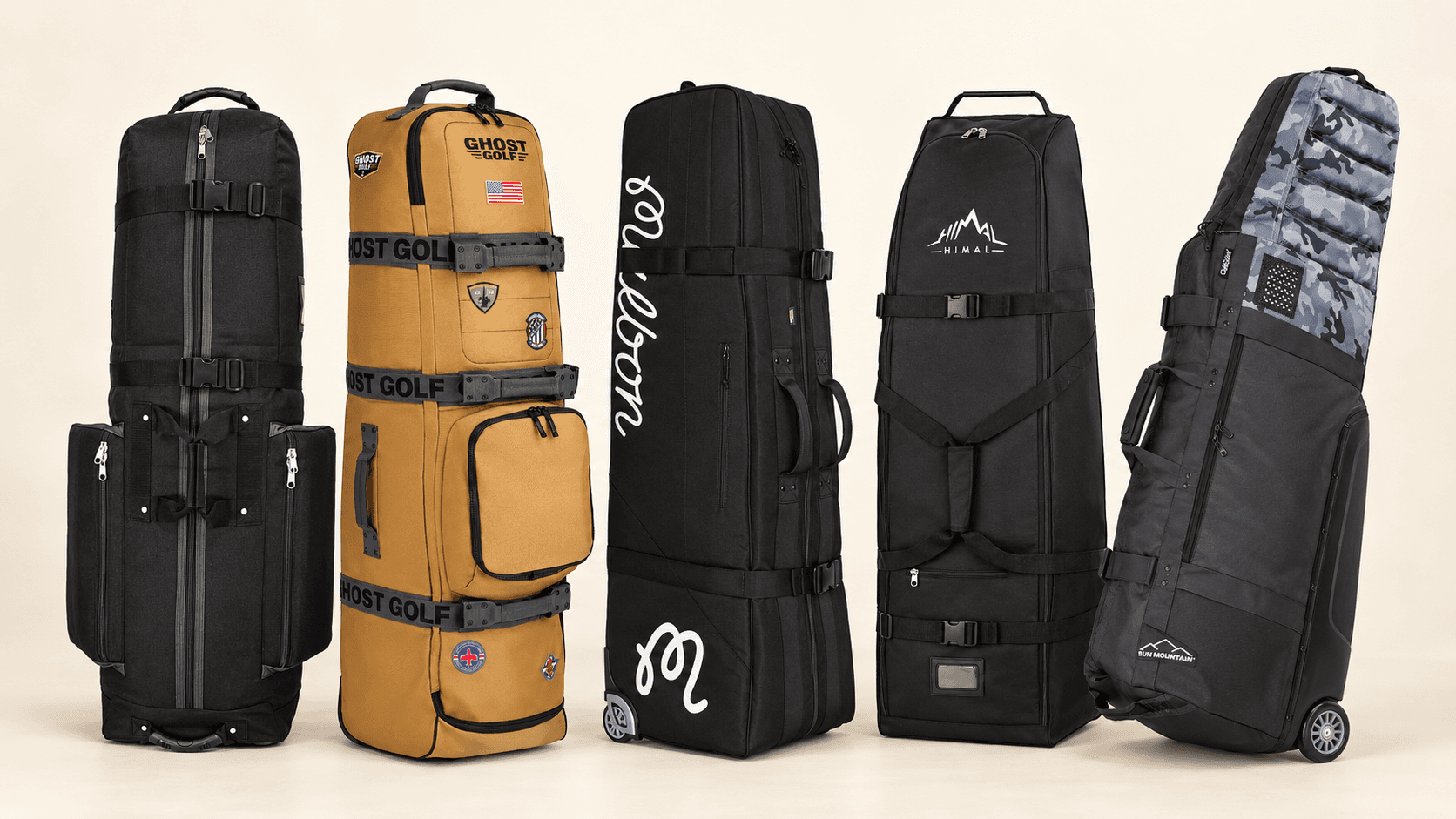
A golf travel bag does not become twice as useful when the price doubles. This group stretches from a basic $44.99 soft cover to a $498 design-led bag, with conventional, style-forward, and mobility-focused options between them. Think of the five as shopping lanes, not places one through five. Prices were checked October 6, 2026 and can change.
| Product example | Price checked | What changes at this price |
|---|---|---|
| Himal Outdoors | $44.99 | Low-cost, lightweight wheeled soft cover |
| CaddyDaddy Constrictor | $129.95 | More padding, straps, pockets, and a one-year warranty |
| Ghost Golf AWOL Dogfight | $350 | Style-forward structured cover with room for larger golf bags |
| Sun Mountain ClubGlider Meridian | $380 | Retractable legs and pivoting wheels for airport movement |
| Malbon Script | $498 | Highest-priced, design-led example in this group |
Himal Outdoors — $44.99. This is the lower-priced example for the golfer who needs a wheeled cover for an occasional trip and would rather keep the budget for the trip itself. At a listed 4.4 pounds, it leaves more of a 50-pound allowance for clubs and shoes. The retailer’s review summary highlights space, carrying straps, airport ease, and value, but it also includes reports of the bottom tearing. That disagreement is the useful part: room and convenience do not settle the durability question. Buy it as a budget cover, not as a promise; use a rigid support pole, pack carefully, and inspect the base after each flight.
CaddyDaddy Constrictor — $129.95. This is the clearest step up before the prices reach the mid-$300s. The Constrictor adds a padded top, heavy fabric, cinch straps, large pockets, and a one-year warranty while staying in a familiar two-wheel soft-cover shape. The selected owner comments make the protection story more specific: golfers liked the capacity and easier loading, and the successful-trip accounts often mention pairing the bag with a rigid North Pole or another club protector. In other words, the bag and the way it is packed work as a system. It suits a golfer who wants more structure and support than the lowest-cost option without turning the travel bag into the trip’s largest purchase.
Ghost Golf AWOL Dogfight — $350. Here, appearance is openly part of the proposition. The structured soft bag is listed at 8.5 pounds, and the seller-hosted comments focus on fabric feel, room for a tour bag, airport compliments, and one successful first trip. That makes the AWOL a plausible choice for someone who wants travel gear to feel considered rather than anonymous. It does not make the bag a proven long-term performer: several comments reflect first impressions or limited travel. Choose this lane if the look, finish, and room are worth paying for after the dimensions work—not because enthusiasm can stand in for years of baggage handling.
Sun Mountain ClubGlider Meridian — $380. This is the higher-priced example with the clearest functional distinction: retractable legs and pivoting wheels that support the bag instead of asking you to drag its full load at an angle. The retailer review summary centers on easy movement through terminals, including one account that describes pushing or pulling it with very little effort, plus room for multiple pairs of shoes. The tradeoff is an 11.3-pound empty case, so the mobility system uses more of the airline allowance before the clubs go in. For a golfer who flies often or dislikes wrestling a loaded bag from curb to carousel, that may be the most meaningful upgrade in this group.
Malbon Script — $498. This is the price that makes you stop and ask what, exactly, the extra money is buying. The listing describes a 600D polyester-oxford body, inline wheels, several handles, an exterior pocket, and a reinforced base, all wrapped in Malbon’s recognizable design language. What it does not show is a distinctive mobility system or long-term test evidence that would make $498 the practical winner. That does not make style frivolous; it makes the choice honest. Pick the Malbon because you want this particular bag and have confirmed the packed fit, return terms, and protection—not because the highest price must mean the safest clubs.
The useful comparison is not cheap versus expensive. It is occasional travel versus frequent airports, low empty weight versus easier rolling, and simple utility versus a design you enjoy owning. The Himal and CaddyDaddy show the lower-priced lanes; the Sun Mountain makes the strongest case for spending up on movement; the Ghost and Malbon make room for style as part of the decision. None is a universal recommendation.
A real ranking would still require repeatable firsthand testing on packed trips. Golf Monthly describes judging travel bags on real journeys for build quality, portability, size, ease of use, and whether the features are genuinely practical. Until BirdieYard completes and documents comparable testing, these five remain product examples to help you choose a lane—not verdicts dressed up as a leaderboard.
A travel bag spends more time being moved than admired. Look at the wheelbase, where the bag balances when tilted, and whether you can reach a sturdy handle from both ends. A bag that twists, falls over, or demands a two-handed wrestling match is harder to move carefully through a curb, counter, carousel, shuttle, and hotel hallway.
If you can inspect the bag in person, pack it with your own golf bag and pull it around. If you cannot, verify internal measurements and the return policy before removing tags. Product photos are very good at showing pockets and very bad at showing the moment a loaded case refuses to turn through a doorway.
The open corners around a golf bag invite optimism: jackets, toiletries, three extra pairs of shoes, perhaps half the clubhouse. Resist until you have read the airline’s allowed-content list. American and Delta, for example, describe a golf bag as clubs, balls, tees, and one pair of shoes. Packing beyond a carrier’s definition can change how the item is charged or handled.
Extra contents also add weight and can create pressure against shafts and clubheads. Use the travel bag as protection for golf equipment first. If the trip requires another suitcase, that is a luggage decision—not proof that the travel bag needs one more expandable pocket.
If this is your first flight with clubs, borrowing a case can teach you more than an evening of product comparisons. You will learn whether you hate lifting a hard shell, whether a soft bag fits your closet, whether the wheels matter more than the pockets, and whether your group’s vehicle plan survives four golfers with luggage.
Renting at the destination can also be the cleaner choice when the trip is rare, the connections are complicated, or the cost and worry of transporting your own set outweigh the benefit of familiar clubs. That is not settling. It is choosing not to buy storage furniture for one weekend of golf.
Your final comparison should happen packed, not imagined. Put the golf bag inside. Check clearance above the longest club. Add only permitted contents. Weigh it. Roll it. Lift it. Measure it against the airline rules and the smallest vehicle on the itinerary. Decide where it will live when you return.
If one case passes those checks, its logo matters less. If none does, the answer may be a different case, fewer packed extras, a borrowed bag, rented clubs, or a larger vehicle. Buying once is not about buying the most bag. It is about refusing to discover the real requirements at the check-in counter.