The Practice · Start
What to expect at your first golf lesson
A practical guide to the questions, observation, focused coaching, and next steps that may shape a first lesson—plus the details to confirm before you arrive.
The Practice · Start
A practical guide to the questions, observation, focused coaching, and next steps that may shape a first lesson—plus the details to confirm before you arrive.
Expect a short conversation about your experience and goals, some observation of how you move and hit shots, focused coaching on one or two useful priorities, and a simple next step to practice. Confirm the meeting place, attire, equipment, balls, lesson length, and arrival time with your coach because those details vary.
You arrive ten minutes early, see two doors marked “Golf Shop” and “Performance Center,” and realize you never asked where the lesson starts. Your clubs are in the car. You are not sure whether you need them. This is a normal first-lesson problem: the uncertainty begins before anyone sees your swing.
Your job is not to arrive with a polished motion or the right golf vocabulary. It is to give the coach enough context to understand what you want, observe what you currently do, and choose one useful place to begin.
Golf facilities do not all work the same way. PGA of America guidance for first-time visitors notes that golfers commonly check in at a golf shop before a lesson, but it also says no two clubs are alike. A stand-alone range, indoor studio, municipal course, and private club may each have a different meeting point.
Send your coach or facility these questions before the lesson:
These are logistics questions, not signs that you are unprepared. The PGA of America Coaching Center’s beginner programs, for example, provide clubs for certain beginner classes and publish their own clothing guidance. That shows why the details matter—and why you should confirm the policy for your lesson rather than borrow another facility’s rules.
A first lesson often begins with conversation because the coach cannot choose a useful priority from one swing alone. PGA professional-training materials describe an opening interview that narrows the lesson objective, followed by observation, adjustments, a practice assignment, and summary questions. LPGA teacher-evaluation guidance similarly starts with an interview, observation, and goal setting before moving into an improvement strategy and feedback.
Be ready to explain why you decided to take a lesson now; whether you are completely new, returning, or already playing; what you would like golf to feel or look like six months from now; and how often you realistically expect to play or practice. Tell the coach about any pain, injury, movement limitation, or safety concern before you begin swinging.
“I do not know yet” is a valid answer. A useful first goal can be as simple as learning how to make contact safely, understanding the lesson process, or leaving with one thing to practice.
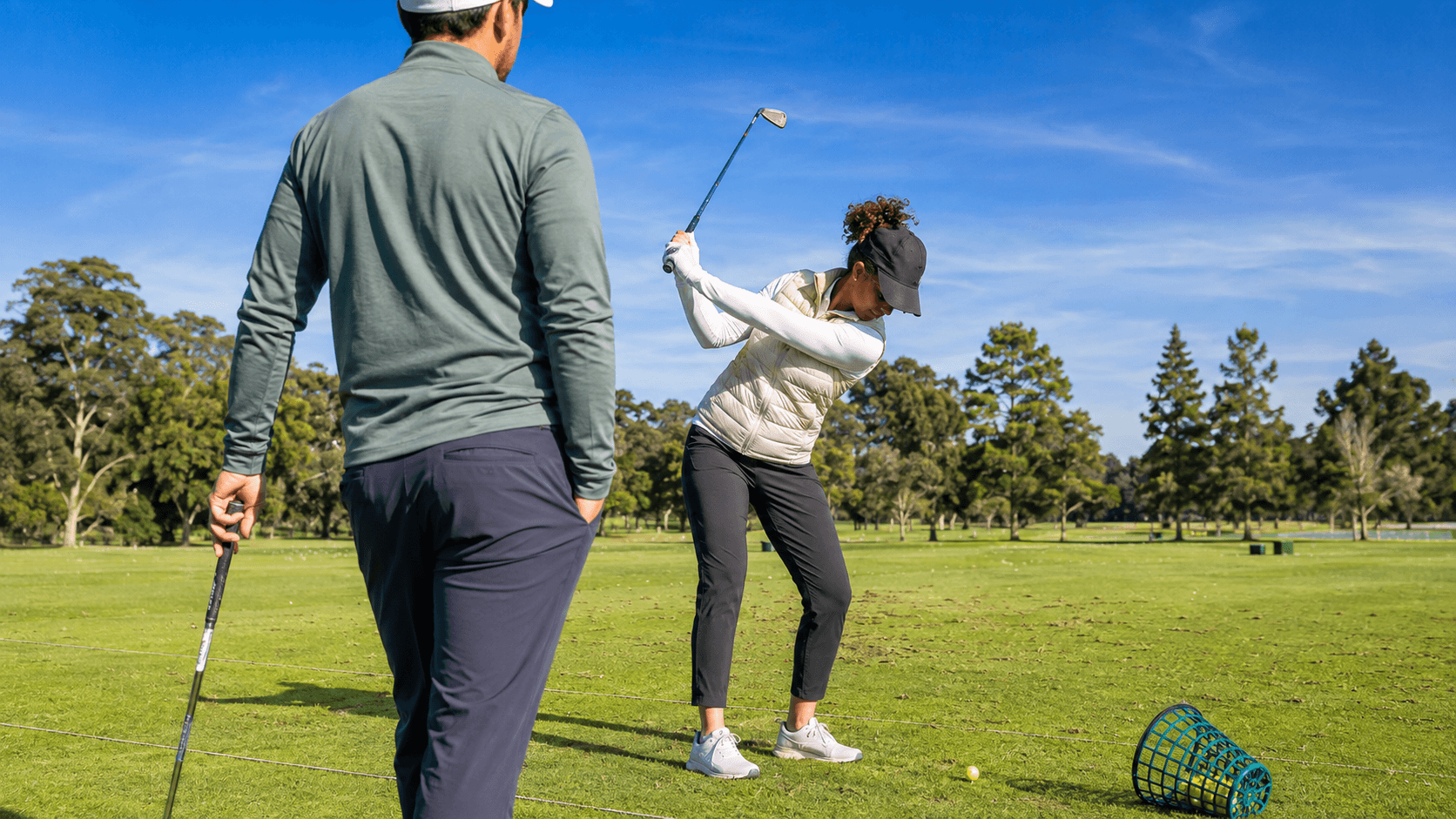
Do not mistake observation for judgment. The coach may ask you to hit a few balls, make a smaller motion, putt, chip, or simply show how you would hold and move the club. They may watch ball flight, club movement, balance, setup, or how you respond to a question.
Technology is optional, not a definition of a serious lesson. Video or launch-monitor numbers may be useful in some settings, while another coach may begin with conversation and direct observation. The PGA Coaching Center’s published process begins with an initial assessment and goal setting before a personalized plan, but that facility’s process should not be treated as a promise about every coach.
You also do not need to hit your best shots to make the lesson worthwhile. A coach needs an honest starting point. Trying to manufacture a “good” swing for the first five balls mostly gives both of you a more confusing puzzle.
A first lesson can expose several things at once. That does not mean all of them should become swing thoughts. The PGA training activity for a beginning-level lesson says the opening interview should narrow the objective and cites a course-manual standard of discussing only one to three topics in a lesson.
For a first-time golfer, the useful priority might be how to hold the club, how to stand safely in the hitting area, how to make a small balanced motion, or how to recognize a solid strike. For someone who already plays, it may be one recurring ball-flight problem. The right priority depends on the golfer in front of the coach.
If you are unsure what the lesson is trying to change, ask two plain questions: “What are we working on first?” and “What should I notice when it is going better?” The second question turns an instruction into something you can observe rather than another sentence to remember.
You can still expect clarity. By the end, you should understand what the coach chose to prioritize, why it matters to your goal, and what to do next. If you do not, ask before the session ends.
The range has a way of making a lesson feel perfectly clear until Saturday, when half the details have wandered off. Before you leave, write down three things:
Both the PGA lesson-training activity and LPGA lesson guidance include a closing summary or practice direction. Ask whether you may take notes, record a short recap, or receive the drill in writing; do not assume the coach or facility provides those formats.
If you have not chosen a coach yet, find a coach whose location, lesson format, and approach fit what you want to learn.
Ask the coach or facility before you arrive. Some can provide loaner clubs, while others expect you to bring your own. Confirming in advance avoids an unnecessary surprise.
Wear clothing that lets you move comfortably and suits the weather, then confirm any facility-specific dress rules with the coach. Do not assume every lesson location follows a golf course dress code.
Usually, the coach will observe your starting point before narrowing the lesson to one or two useful priorities. A first lesson does not need to become a complete swing rebuild to be valuable.
You do not need to arrive with a polished swing. Come with an honest starting point, a clear goal, and any relevant physical limitations or concerns so the coach can make the lesson more useful.
Prepared from current PGA of America facility guidance, PGA professional-training materials, and LPGA teacher-evaluation guidance. Facility and program examples are treated as examples rather than universal promises.
No coach, facility, equipment company, or affiliate paid for inclusion. The article does not claim firsthand lesson testing.
Read our editorial standards and corrections policy.
Start
Breakfast balls, mulligans and a little mercy for terrible lies. The Jared Rules make casual golf more fun—as long as everyone knows the deal.
Improve
A beginner’s first useful score is a trustworthy hole score—not necessarily an 18-hole total. Here is what to count, what to write, and when to put the pencil away.
Featured Coaches
At Alameda Precision Golf, Larry Zhou brings an athlete’s enthusiasm and a data professional’s curiosity to the swing. The goal: give golfers something they can see, understand, and take back to the range.