The Practice · Start
Your first trip to the driving range: what to do with the first bucket
A beginner-friendly way to learn the range, stay safe and considerate, and finish your first bucket with something more useful than a pile of swing thoughts.


The Practice · Start
A beginner-friendly way to learn the range, stay safe and considerate, and finish your first bucket with something more useful than a pile of swing thoughts.
On your first driving-range trip, use the first bucket to learn the facility, practice safely, and work toward one visible target with one simple purpose. Do not race through the balls or rebuild your swing after every miss. Check local rules, give nearby golfers room, and finish by naming one pattern or question to bring to your next session.
Range balls have a particular talent: a full tray looks endless until the first ten disappear. A new golfer can arrive thinking the first bucket is a chance to learn golf and leave having mostly learned that it is possible to hit golf balls much faster than expected.
The first bucket does not need to be a swing exam. It has a better job: help you learn the place, settle into the rhythm of a shared practice area, and leave with one useful thing to notice next time. The goal is not to look experienced. It is to become a little less lost.
A driving range may be part of a course, a stand-alone facility, an indoor space, or a practice center. Check-in, balls, available clubs, grass or mat access, and local restrictions can differ. PGA of America guidance for first-time golf-facility visitors makes the useful point that no two clubs are alike and recommends asking staff where the practice area is and which local policies matter.
Tell the person at the counter or desk that it is your first visit. Ask where to get balls, where you are allowed to hit, whether any clubs are available, and whether there are posted rules you should know. This is not an admission that you do not belong. It is the quickest way to avoid borrowing the customs of some other range from a video or a friend.
Before taking a club out, spend a minute watching the space. Notice the active hitting line, where people walk behind the bays, where bags and baskets sit, and how staff signal any interruption. Do not assume an open patch of grass is open for play. At a range, orientation is part of practice.
Golf asks people to swing a metal club while other people stand surprisingly nearby, so predictable movement matters. The R&A advises golfers to make sure no one is close enough to be hit by the club or ball before a stroke or practice swing and to wait until people ahead are out of range.
At the range, look around before every swing, including a practice swing. Stay in the space the facility assigns. If a ball rolls forward, leave it there unless staff explicitly says it is safe to retrieve it. Follow any pause, bell, light, or verbal instruction immediately; the facility's direction wins over a general article.
A topped ball, a whiff, or a shot that travels somewhere unhelpful is ordinary beginner golf. Moving unexpectedly into another golfer's swing area is the problem. Bad shots are allowed. Unpredictable traffic is not.
Once the space makes sense, the bucket needs a purpose. By the twelfth ball, the brain may have proposed a new grip, a wider stance, a slower backswing, a faster downswing, and something remembered from a thirty-second clip. That is not a practice plan. It is a committee meeting.
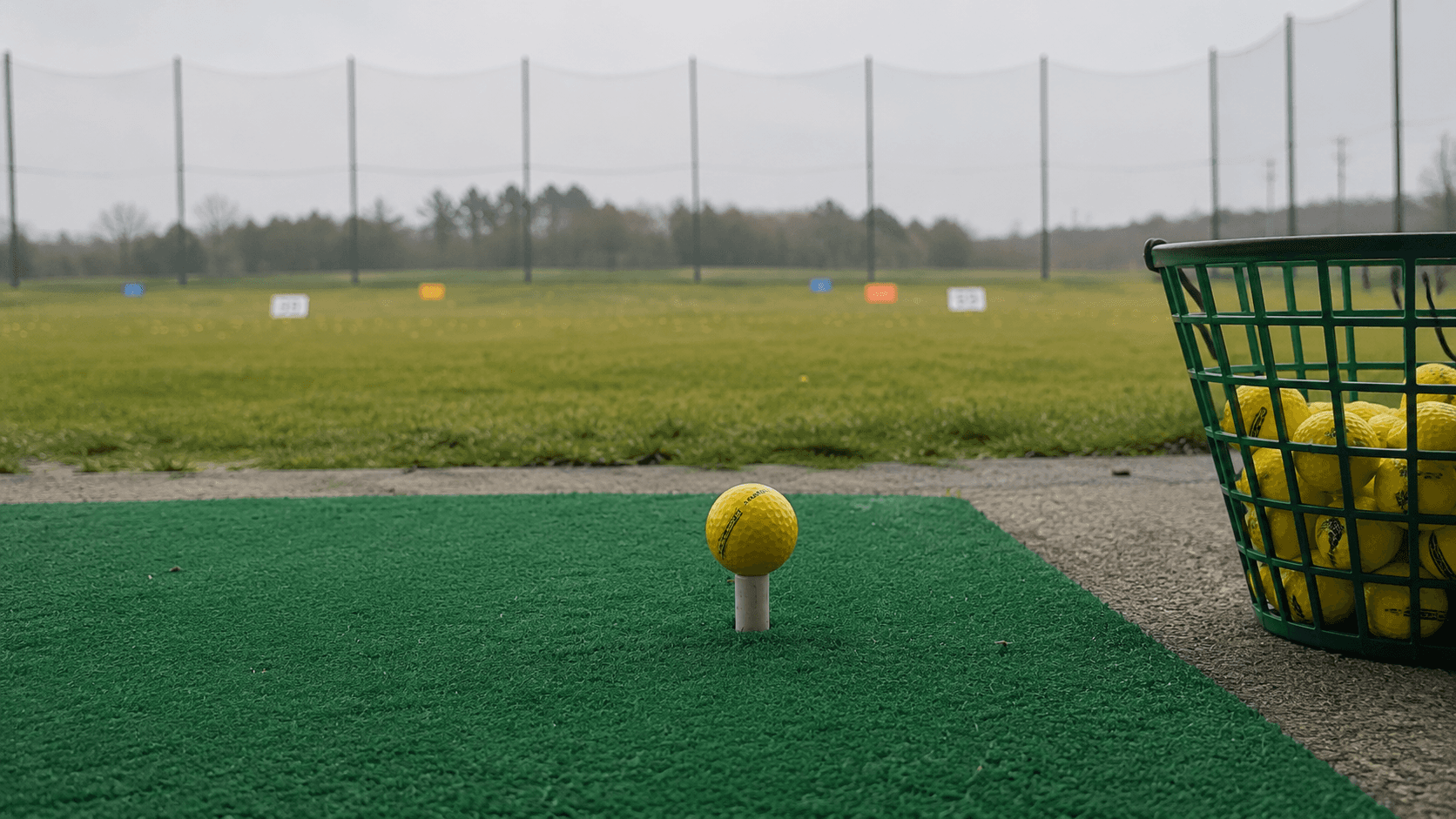
Choose one visible target and one simple question for the session. The target can be a flag, sign, or safe area identified by the range. The question might be whether you can start the ball toward it, notice where contact happens, or finish without losing your balance. PGA of America range-practice guidance similarly recommends choosing a target and deciding on one focus before hitting balls.
This is practice structure, not a diagnosis of your swing. If you do not know which club or task makes sense, ask a coach or staff member for a basic starting point. What matters is resisting the urge to treat every miss as evidence that you need a different fix.
Let a few shots happen before judging the pattern. One great ball can be an accident; one terrible ball can be golf. Look for what repeats. Did the ball often begin left or right of the target? Did you lose balance in the same direction? Could you tell when contact felt different? A useful observation is more portable than a swing tip you do not understand.
Range etiquette is mostly the art of making your practice predictable. Keep your bag, basket, and phone out of the walking path. Give the golfer beside you room to swing. Keep calls, music, and conversation at a level that does not become everyone else's soundtrack. If you want to film, frame your own space rather than collecting strangers in the background.
And let other golfers own their swings. A person hitting nearby may be working on something that looks odd on purpose, trying a coach's assignment, or simply having a day. Unrequested swing advice is not a welcome gift merely because it is free. The considerate move is usually to let them practice.
A bucket often ends with a rattle, three quick swings, and the vague feeling that the important ball was going to be the next one. When only a small handful remains, stop adding ideas. Return to the same target and the same question. Take enough time between shots to notice what happened.
Then write one sentence before the details wander off: “Most of my shots did ___, and next time I want to notice ___.” The sentence does not need golf vocabulary. “The ball kept starting right, and I could not tell why” is more useful than pretending you solved it. It can guide the next range visit or give a coach a real question to work with.
There is no score for a first range trip. Success is knowing how the facility works, moving safely through the space, finding a pace that lets you think, and noticing one repeatable thing. You may hit several satisfying shots. You may hit none. Neither result settles whether you can become a golfer.
If the session makes you want more swing advice, keep the order straight: build beginner golf foundations before chasing fixes, and get individual feedback when you cannot explain the priority or the result. The range is good at revealing questions. It is less good at telling you which answer fits your swing.
Golf offers endless ways to make a first bucket feel insufficient. You do not need all of them. If you left safely, did not hurry through the tray, and can name one thing you want to notice next time, you used it well. The bucket is empty. Your attention does not have to be.
Yes, but check the facility's current access, check-in, equipment, and local rules before you go. Tell staff it is your first visit and ask where to start; you do not need a finished swing or golf vocabulary to use the range considerately.
Not always. Some facilities offer loaners or rentals and others do not, so confirm before arriving. If you already have clubs, you do not need to bring every club in the bag for a first session with one clear purpose.
There is no useful universal pace. Go slowly enough to check the space, choose a target, make the swing, and notice the result before the next ball. Finishing the bucket is not the goal if your attention has already left.
Missing the ball does not make the visit a failure. Avoid changing several things after every attempt. Keep the area safe, note what repeats, and ask a coach for individual help if you cannot identify a useful priority or if anything causes pain.
Prepared from PGA of America guidance for first-time facility visits and driving-range practice, plus The R&A's safety guidance. Local range logistics are treated as variable rather than universal.
Read our editorial standards and corrections policy.
Improve
Build a safe, focused practice structure before collecting grip, posture, and swing advice that may not fit your motion or goal.