The Practice · Start
Private or group golf lessons: which is right for you?
Private lessons concentrate the coach’s attention; group lessons add shared learning and often more structure. Compare the actual session, not the label.

The Practice · Start
Private lessons concentrate the coach’s attention; group lessons add shared learning and often more structure. Compare the actual session, not the label.
Choose a private golf lesson when you want the coach’s attention centered on your goals, questions, or specific pattern. Choose a group lesson when you value a structured introduction, learning beside others, and potentially lower per-person cost. Neither is automatically better. Confirm group size, session length, curriculum, coach access, equipment, price, and follow-up before deciding.
“Group lesson” can mean a scheduled beginner class, a clinic built around one theme, or an hour shared with two friends. “Private lesson” sounds more precise—one golfer, one coach—but it still does not tell you whether the hour will follow your goal or somebody else’s standard routine.
The labels are often treated like a quality ranking: private is serious, group is the economical warm-up. That is the wrong contest. The real choice is where the coach’s attention goes, who sets the agenda, and whether learning beside other golfers helps you or gets in the way.
Current programs show how much the meaning can vary. McInnis Park Golf Academy separates private lessons, small lessons shared with one or two other golfers, and scheduled adult group classes. Those are three different learning arrangements even though two may be advertised with the word “group.”
The PGA of America Coaching Center likewise offers beginner classes and clinics alongside private coaching, and describes group lessons and events as a way for beginners to connect with the golf community. A class with a sequence and a roomful of new golfers is not the same product as splitting a private hour with a friend.
Before comparing formats, ask what the format actually contains. How many golfers will be there? Is the session built around a shared curriculum or each person’s question? Will the same golfers and coach return next time? How much individual feedback is normal? Are clubs, balls, practice time, notes, or follow-up included? The name on the menu cannot answer any of that.
Private coaching is most useful when you need the coach to spend the session understanding your starting point and adapting to what happens in front of them. Haggin Oaks describes its private lessons as a one-on-one environment for golfers who learn best that way or have specific questions about their game. That is a sensible definition, not a promise that every private lesson will be personalized equally well.
Private may fit when one ball-flight pattern keeps returning, a previous explanation never made sense, you have a particular playing goal, or you want space to ask basic questions without tracking a class at the same time. It can also make logistics simpler when your schedule does not match a program’s fixed dates. None of those needs makes a golfer more committed than someone in a group. They simply benefit from concentrated attention.
One-on-one attention is not automatically useful attention. A coach can still offer six ideas when one would do, or spend the hour solving a problem you did not come to solve. Ask what the coach wants to learn about you at the start, how you will agree on the session’s priority, and what you should be able to describe or practice when the lesson ends.
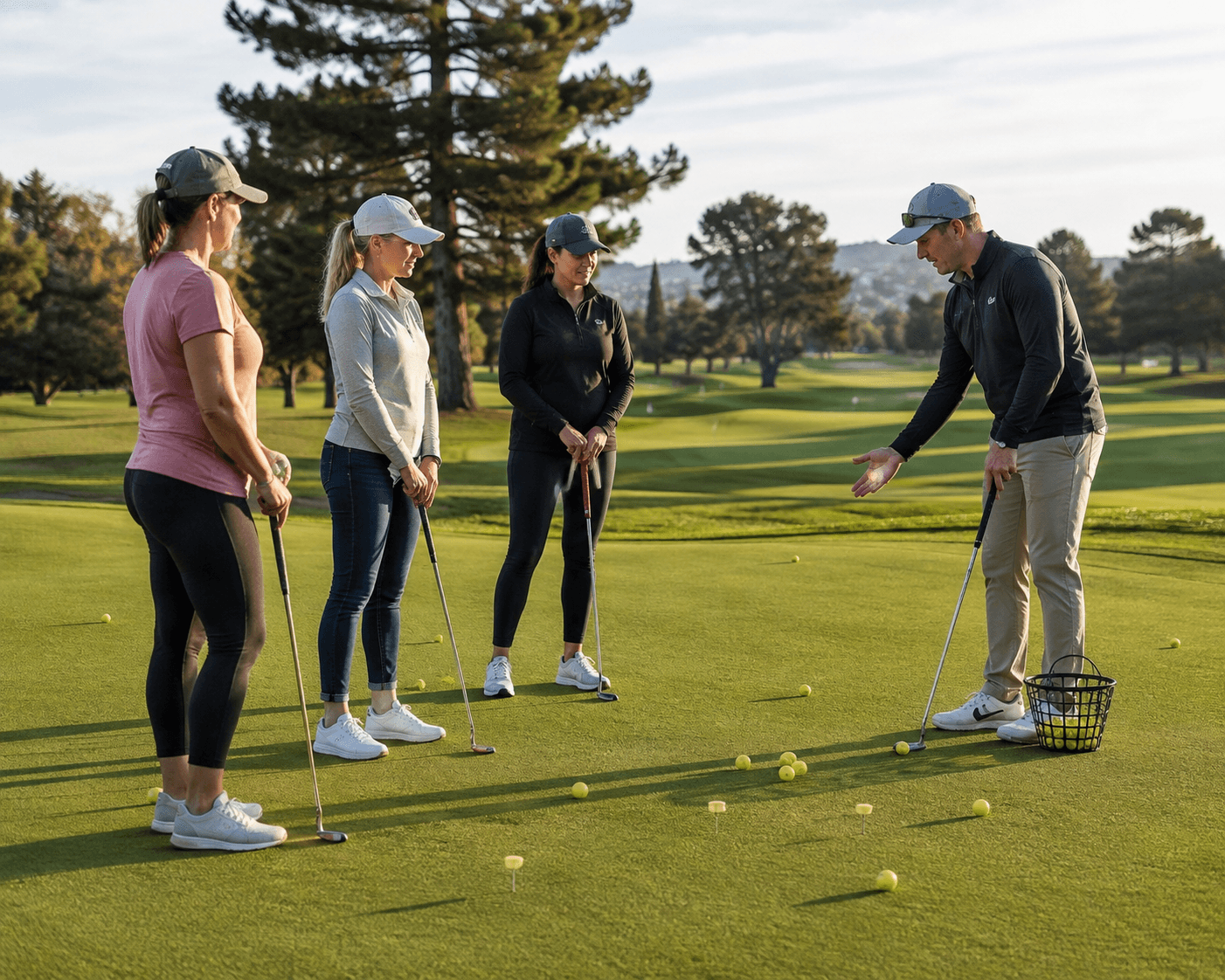
A good group setting can make golf less mysterious. You hear questions you did not know to ask. You watch another beginner misunderstand something, then understand it. You wait a moment, try again, and discover that not every miss needs immediate intervention. For a golfer learning the broad shape of the game, that shared rhythm can be useful rather than diluted.
Group formats also tend to make the most sense when the subject is shared: an introduction to grip and setup, short-game basics, etiquette, or getting ready to play. The PGA of America Coaching Center’s published beginner classes move through a stated beginner curriculum over either one session or a multiweek series. That example is one facility’s program, but it shows the central tradeoff: the class provides structure and company while the coach’s attention is divided among the group.
Group does not automatically mean welcoming, inexpensive, or beginner-ready. A clinic can move too quickly for one golfer and feel repetitive to another. A class advertised for all levels may still have an assumed starting point. Confirm the intended experience level, group size, pace, and whether the coach creates individual moments inside the shared plan. If you need the coach to follow one specific question across several swings, ask directly how much of that the format allows.
| Decision | Private tends to fit | Group tends to fit |
|---|---|---|
| Where should the attention go? | Your goal, question, and responses | A shared theme, with individual turns |
| How do you like to learn? | Ask, try, and adjust with privacy | Watch, try, and learn beside others |
| How flexible should the agenda be? | Able to change around what the coach sees | Usually more structured around the group |
| What must you confirm? | Duration, coach, focus, follow-up, total price | Group size, curriculum, dates, equipment, per-person price |
If your answers land in both columns, that is normal. The formats can be a sequence rather than an identity. A golfer may use a group class to learn the vocabulary and rhythm of practice, then take a private lesson when a specific question appears. Another may begin privately to feel oriented, then join a group for repetition and company. Choose what removes the biggest obstacle now.
Group instruction may cost less per golfer, but a useful comparison needs the same denominator. McInnis Park publishes different durations and prices for private sessions, small shared lessons, and longer-running group classes. Other facilities package balls, equipment, practice access, or multiple dates differently. Compare minutes with the coach, number of sessions, group size, included equipment or fees, cancellation terms, and what happens if you miss a class. A lower price for an experience you cannot attend or use is not a bargain.
Format is only one part of fit. A clear private offer from the wrong coach is still the wrong lesson, and a thoughtful group program can be a better beginning than an impressive biography. Use the same goal, communication, trust, and logistics checks in BirdieYard’s guide to choosing a golf coach, then ask the coach to explain the actual lesson format in plain language.
Private buys concentration. Group buys context and company. Neither buys improvement by itself. The right choice is the format whose tradeoff you can name before the first ball—not the one that sounds more serious on the lesson menu.
They can be, especially when the class is explicitly designed for beginners and explains equipment, basic skills, and how practice works. Confirm the starting level, group size, pace, curriculum, and whether clubs are available; the word “group” alone does not establish beginner fit.
No. Private lessons concentrate attention on one golfer, while group lessons can add structure, observation, repetition, and social comfort. The better format is the one that matches your current question, preferred learning environment, schedule, and budget.
Often, but facilities label shared sessions differently. Some offer a small lesson for two or three golfers; others use “group lesson” for a scheduled class. Ask whether you can enroll together, how the coach divides attention, and whether both golfers should have similar goals or experience.
They often cost less per golfer, but compare session length, number of meetings, group size, included balls or equipment, coach access, and cancellation terms. A multiweek class and a one-hour private lesson are different products, so the headline price does not settle the value.
Compared current public descriptions of private lessons, small shared lessons, beginner classes, and clinics from the PGA of America Coaching Center, Haggin Oaks, and McInnis Park Golf Academy. The article treats program names, group size, inclusions, schedules, and prices as facility-specific rather than universal.
Read our editorial standards and corrections policy.
Choose
A practical way to compare coaching goals, communication, credentials, logistics, and the first-lesson experience without chasing the flashiest profile.
Start
A practical guide to the questions, observation, focused coaching, and next steps that may shape a first lesson—plus the details to confirm before you arrive.